New owner, new name, same big empty field
This is one of a series of posts about the South Mimms data centre: DC01UK: Hertsmere steps into history (Feb 2025); DC01UK: a demanding new neighbour (March 2025); DC01UK: data centre drama (April 2025); DC01UK: South Mimms and the global backlash (November 2026).The biggest data centre project in Europe (at least that’s what they tell us) has a new owner and a new name and its first detailed plans have been submitted. It’s been a while since we updated this story and quite a lot has happened since we last looked, in the Spring of last year.
It’s been about 18 months since a field next to South Mimms services became, briefly, the most talked-about patch of green belt in the country. We covered the DC01UK data centre three times in the first half of 2025. Then things went quiet for a while, at least in public. There’s a lot more going on now. The developers who secured Hertsmere’s outline permission have sold up (we don’t know the purchase price but we suspect there are now some very happy local business owners), a US giant has moved in and the timetable has slipped a bit. Also, inevitably, perhaps, Potters Bar is a lot less relaxed about all this than the planning committee was.
The story so far
If you’re just joining us, here’s the short version.
- The plan. A company called DC01UK (formerly Hilfield Battery Storage, backed by local housebuilder Griggs and Chiltern Green Energy) applied in September 2024 to build up to 187,000 square metres of data centre on 85 acres of green belt farmland east of South Mimms services, beside the M25. Hertsmere’s planning committee gave it outline permission on 23 January 2025. The suggested cost of the development was £3.75bn and it was billed as Europe’s largest cloud and AI data centre. The numbers all seemed so huge at the time but it has to be said that the explosion of the AI economy since then has made the whole thing look rather moderate. We wrote about the big picture in Part 1: Hertsmere steps into history.
- The appetite. National Grid has reserved 400MVA for the site via the Elstree substation at Letchmore Heath. For context, this is a vast amount of electricity – a peak of about 360MW, which we calculated was roughly 1% of UK electricity demand (we reckon we might have over-estimated that number but not by much, it’s probably something like 0.7% of total UK demand). AI’s vast appetite for electricity turns out to be the most significant constraint on its growth everywhere so a ready supply on this scale is a breakthrough and, if the National Grid can actually deliver on time, it’ll be the site’s biggest asset. The big unknown was water. In Part 2: a demanding new neighbour we used public numbers to estimate that the South Mimms data centre would need 250 million litres per year if it used conventional evaporative cooling.
- The obstacles. In Part 3: data centre drama we looked at what might stop it: local opposition, funding (it was clear then that the developers were never going to run it), the DeepSeek wobble over AI demand (still a massive concern for the whole industry) and US tariffs and chip rules. The Government had just redefined data centres as critical national infrastructure and then minister Peter Kyle had mentioned DC01UK by name. Planning looked like the easy bit.
What’s happened since
| When | What happened |
|---|---|
| 17 August 2026 | Equinix submits its first reserved matters application, 26/1187/REM (Phase 1a: roads, drainage, substations, landscaping). 112 objections so far, none in support. National Highways and National Grid lodge holding objections |
| August 2026 | University of Hertfordshire report: 62% of Potters Bar adults oppose the data centre |
| April 2026 | CPRE Hertfordshire report questions whether Herts is the right place for data centres |
| February 2026 | Equinix holds its first public exhibitions at Dame Alice Owen’s School. Wired covers the row |
| January 2026 | Government concedes that its approval of a green belt data centre at Iver was flawed |
| 30 October 2025 | DC01UK sells the site to Equinix. It becomes the “Hertfordshire Campus” |
A new owner and a new name
The biggest news came on 30 October 2025, when DC01UK announced it had sold the site to Equinix. Equinix is one of the world’s biggest data centre operators, based in California, with 14 facilities in the UK already (Equinix is one of those monster corporations it’s hard to get your head around: the firm has about $10B in annual revenue and $25B in debt – and now they’re in a field in South Mimms). That answers one of the big questions from Part 3: who would actually build and run this thing. We know now that it’s not one of the hyperscalers we thought it might be. Equinix rents space to them and to everyone else.
Equinix has renamed the site the Hertfordshire Campus and talks about a £3.9bn investment and 250MW+ of computing capacity (it’s telling that computing capacity is these days measured not in ‘instructions per second’ or megahertz but in megawatts). The sale price wasn’t disclosed but the new Technology Secretary Liz Kendall (Kyle’s replacement) called the deal “a huge win for Britain”. DC01UK’s directors called it a triumph of local entrepreneurship and said they’d go looking for other UK sites.
The timetable has slipped a year
DC01UK always said 2030. Equinix now says 2031. According to its FAQ page, construction starts in 2027 and opening is lined up with National Grid’s connection, now also due in 2031 – evidence that the site’s vast electricity demand isn’t necessarily “already sorted.” OFGEM estimates that the grid queue – the waiting list for electricity supply – attributable to data centres already runs to a mind-boggling 73GW across 315 UK projects (these calculations are tricky and many of those projects won’t happen but that’s roughly twice the UK’s current total demand for electricity).
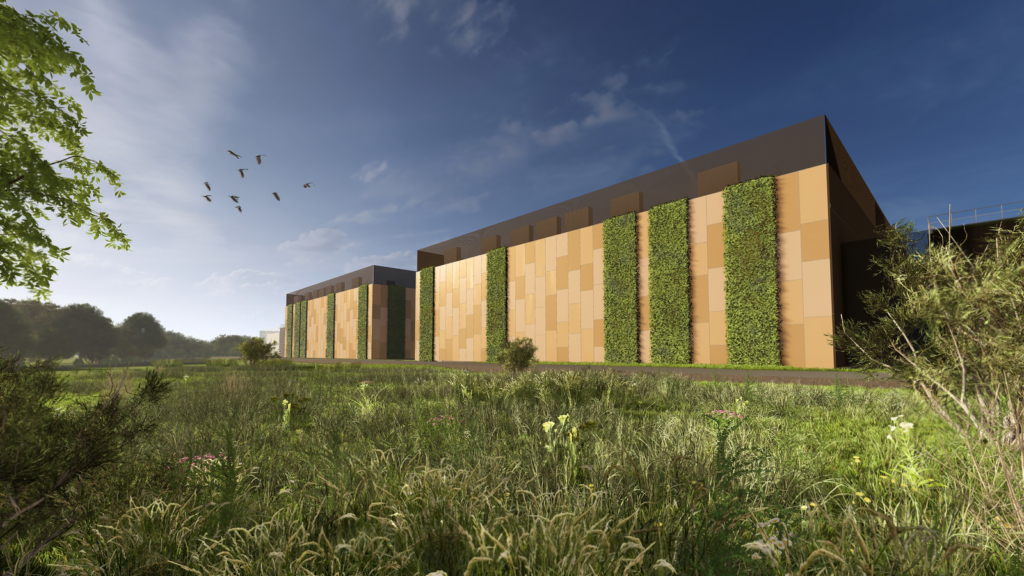
At South Mimms, the plan is now for four buildings: three of 72MW and one of 48MW, according to the Barnet Society’s account of the February exhibition. (Yes, that adds up to 264MW, not 250. Nobody seems quite sure.) Buildings will be up to 23m tall, which Equinix says is roughly tree height.
The detailed plans are in
Outline permission only settles the principle. The details (layout, scale, appearance, access, landscaping) come later as “reserved matters”. Equinix’s first batch of plans, Phase 1a, went in on 17 August 2026 as application 26/1187/REM. It covers the site-wide groundwork: the Swanland Road entrance, internal roads, parking, drainage ponds, bridges, a security gatehouse, substations, service yards, landscaping and the platforms the buildings will sit on. The data centre buildings themselves will come in later applications. Most of the surveys (archaeology, ecology) were done by early August 2026.
It’s not been quiet on the planning website. The council consulted 1,981 neighbours and 112 have commented so far (as of 21 November when we checked). Every one of them objects and none supports it. 80 statutory consultees have been asked as well, including Affinity Water, Thames Water and Welwyn Hatfield council and 21 have replied. The application has 129 documents, which gives you some idea of the scale of the thing.
What the official bodies said
Phase 1a is supposed to be the boring bit: roads, ponds and a gatehouse. It hasn’t had an easy ride.
- National Highways has recommended that permission not be granted until a drainage question at the new Swanland Road entrance is sorted out. It also wants a 2m maintenance strip kept clear along the M25 boundary and details of the security fencing.
- National Grid has a holding objection too. It wants updated plans showing enough room around one of its pylons (tower ZB186) for access and maintenance.
- The council’s landscape advisers (Place Services) want more information before a decision. They welcome a bigger gap between the buildings and the Western edge of the site. But they’ve spotted a new road along the Eastern edge that wasn’t in the outline plans and asked for the visual assessment to be updated.
- Hertfordshire’s ecology advisers have no objection, as long as the updated protected species surveys (a planning condition) are signed off first.
- The county’s drainage team is satisfied with the ponds and bridges. Hertfordshire Highways doesn’t want to restrict permission.
- Natural England, Historic England and Barnet council had nothing to say. SIGRA points out that Natural England said it hadn’t assessed protected species, so “no comment” isn’t a clean bill of health.
- CPRE Hertfordshire repeated its opposition in principle and asked for clarity on power and water. It also said the Environment Agency had objected over a missing flood risk model. That objection isn’t filed on this application, so it may relate to one of the linked condition applications.
What SIGRA found
SIGRA, the Potters Bar Special Interest Group Residents Association, a volunteer-run community group, has done some remarkable work, by any standard. The group has gone beyond objecting and has paid for its own expert reviews: one of the air quality assessment by Kalaco Group and one of the noise assessment by the Industrial Noise and Vibration Centre. Its most striking finding is about generators. The outline application talked about roughly 144 backup diesel generators. The air quality assessment for Phase 1a models 185.
It’s worth pausing on how SIGRA goes about this, because it isn’t the usual “not in my backyard” letter. The group starts by accepting that the principle of the data centre is settled, then sticks to what reserved matters can legally cover. Its members have measured the Bridgefoot Lane gateway themselves, compared generator numbers across documents and picked up the caveat in Natural England’s “no comment”. They’re following the linked condition applications as well as the main one. Their air quality expert, Kieran Laxen, is a full member of the Institute of Air Quality Management. It’s a residents’ group, funded by donations, checking the paperwork of one of the world’s biggest data centre companies line by line. Whether or not the council agrees with them, it will have to answer them.
Other points in SIGRA’s four submissions:
- Testing those generators adds up to 2,220 hours a year. Kalaco worked out that’s like one generator running eight hours a day, every weekday, all year.
- The Bridgefoot Lane emergency access isn’t where the outline plans put it. It’s about 20m away from the existing farm gate and needs a veteran oak (tree T42) to be felled.
- The drainage discharge rate seems to have been raised by a factor of 2.3. SIGRA asks who agreed to that and when. It also asks whether pollution could reach the Water End Swallow Holes SSSI downstream.
- It cites a diesel spill at an Equinix data centre in Secaucus, New Jersey, in September 2026: around 20,000 litres, caused by a valve failure. SIGRA asks whether the drainage design can cope with a spill like that.
- It has asked for Phase 1a to go to the planning committee rather than be decided by officers.
Equinix’s consultants, Arup, replied on 6 November. Their position is that the air quality and noise work is robust and deliberately pessimistic. On noise, they assumed every piece of equipment running flat out on a 40°C day. They say the detailed air modelling belongs at the later Environment Agency permit stage, not here. They also say the cooling system won’t use ammonia. They don’t dispute the SIGRA’s 185-generator figure. They do concede that if all the generators ran at once in a power cut, short-term nitrogen dioxide levels could breach the official assessment level, but they say a long enough grid failure is very unlikely.
The main entrance will be off Swanland Road. Bridgefoot Lane, opposite Dame Alice Owen’s School, will be for emergency vehicles, walkers and cyclists only. The emergency gate opposite the school entrance surprised County Councillor Simon Rhodes, who told the Barnet Society “we are only just finding out what Equinix is proposing”.
Good news on water (possibly)
In Part 2 we worried about water and guessed at a staggering 250 million litres a year. Equinix says it will use closed-loop dry cooling, so water use should be “comparable to conventional office buildings”. If that holds, it’s a big improvement and answers our biggest environmental question. The trade-off is that dry cooling uses more electricity, especially on hot days. It’s also worth noting that this way of cooling computer systems is still relatively new, expensive to implement and largely untested. Intriguingly Equinix also says the campus will be “heat export ready” if someone builds a heat network nearby and will fund its side of the connection. There are no takers that we know of yet, but this would be a real gain for the local community and potentially a very promising opportunity for a housing developer – or perhaps for the school over the road – free or low-cost heat and, given the scale of the project, plenty of it (it wouldn’t be the first such scheme in the UK but it would certainly be the biggest).
There’ll be diesel backup generators. Equinix says they’ll only run in emergencies and for short daytime tests. Campaigners say that undermines the “100% renewable” claim, which rests on power purchase agreements and certificates rather than a direct supply. In truth, almost every existing data centre has diesel generators on-site and this one, being absolutely enormous, will need a lot of them: 185 generators in the latest plans, up from about 144 at outline stage. More on that below.
Potters Bar finds its voice
In Part 3 the opposition to the development was a fledgling campaign. It has grown. SIGRA is now the main campaign group, with a fundraiser to pay for expert advice on the reserved matters. Cllr Rhodes’s group says it has logged 950 objections since January. The row has gone national: Wired visited in February and UnHerd followed in April. Both took “grey belt” as their theme: the new planning category that let the council treat this as green belt land that doesn’t really do the job.
According to Wired, campaigners have complained to an ombudsman, to the Office for Environmental Protection and to the standards process about the council leader. So far all of those have been dismissed.
A University of Hertfordshire poll in June 2026 found 62% of Potters Bar adults oppose the data centre, with only 8% in favour. We’ll look at that report, CPRE’s case against siting data centres in Hertfordshire and how the fight here fits into the worldwide backlash in our next post.
What’s sweetening the deal
Equinix says it will honour DC01UK’s commitments: £2m for the 398 bus, a new Hertsmere Hopper bus, cycle routes and a cycle hire scheme. It also cites over 50% of the site kept as green space, 10% biodiversity net gain, about 2,500 construction jobs, 200 permanent jobs and roughly £18–20m a year in business rates (you’ll find several different numbers for the rates gain in the published documents so we should probably take all these figures with a pinch of salt. In the UH survey, 9% of residents expected to see any benefit.
What happens next
The next real decision belongs to Hertsmere: whether to approve Phase 1a. That won’t happen while National Highways and National Grid have holding objections in place and the ecology sign-off depends on another condition being cleared first. The council’s 13-week target date of 16 November has passed. Consultation reopened on 6 November after Arup’s replies came in and runs to 27 November. A decision before the new year looks unlikely and SIGRA wants councillors, not officers, to make it. If you want to comment, the application page is the place. Later reserved matters applications (Phases 1b, 2 and 3) will cover the buildings themselves. That’s when we’ll finally see what they look like.
Could it still be stopped? This is probably less likely than it looked in Part 3. The money question is answered and the outline permission has survived every complaint so far. The challenge that worked elsewhere was legal. In January 2026 the Government conceded that its approval of a green belt data centre at Iver, in Buckinghamshire, was flawed. The reasoning on environmental assessment didn’t hold up. That was a ministerial decision, not a council one. But it shows that the paperwork behind these schemes can be challenged.
Things we’d like to know now:
- How many megawatts, exactly? Is it 250MW, 264MW or the 360MW the grid reservation allows?
- What will the generators emit and how often will they actually run?
- Will anyone build the heat network that makes “heat export ready” mean something?
- How many of the 200 permanent jobs will go to local people?
- How will construction traffic be managed around Dame Alice Owen’s and Bridgefoot Lane?
We’ll keep the DC01UK tab updated (although we should probably change the label). Do you live near the site, or have you been to the exhibitions? Tell us in the comments.
- Something new since the last time we wrote about the data centre: we’ve made careful use of an AI (Claude to be specific) in trawling the planning documents. Everything’s been checked but there’s obviously a chance that Claude has made mistakes or introduced hallucinations. If you spot anything wrong with our data or with the information from the planning documents, please leave a comment or send us an email.
- There are hundreds of documents on the Hertsmere planning portal and we have not read them all. If you think we’ve missed anything important, made a mistake or got the emphasis wrong, please leave a comment or send us an email. We’ll correct or update the post.
Leave a Reply